

The Shadow Warrior: Understanding the Dark Side of Masculine Strength
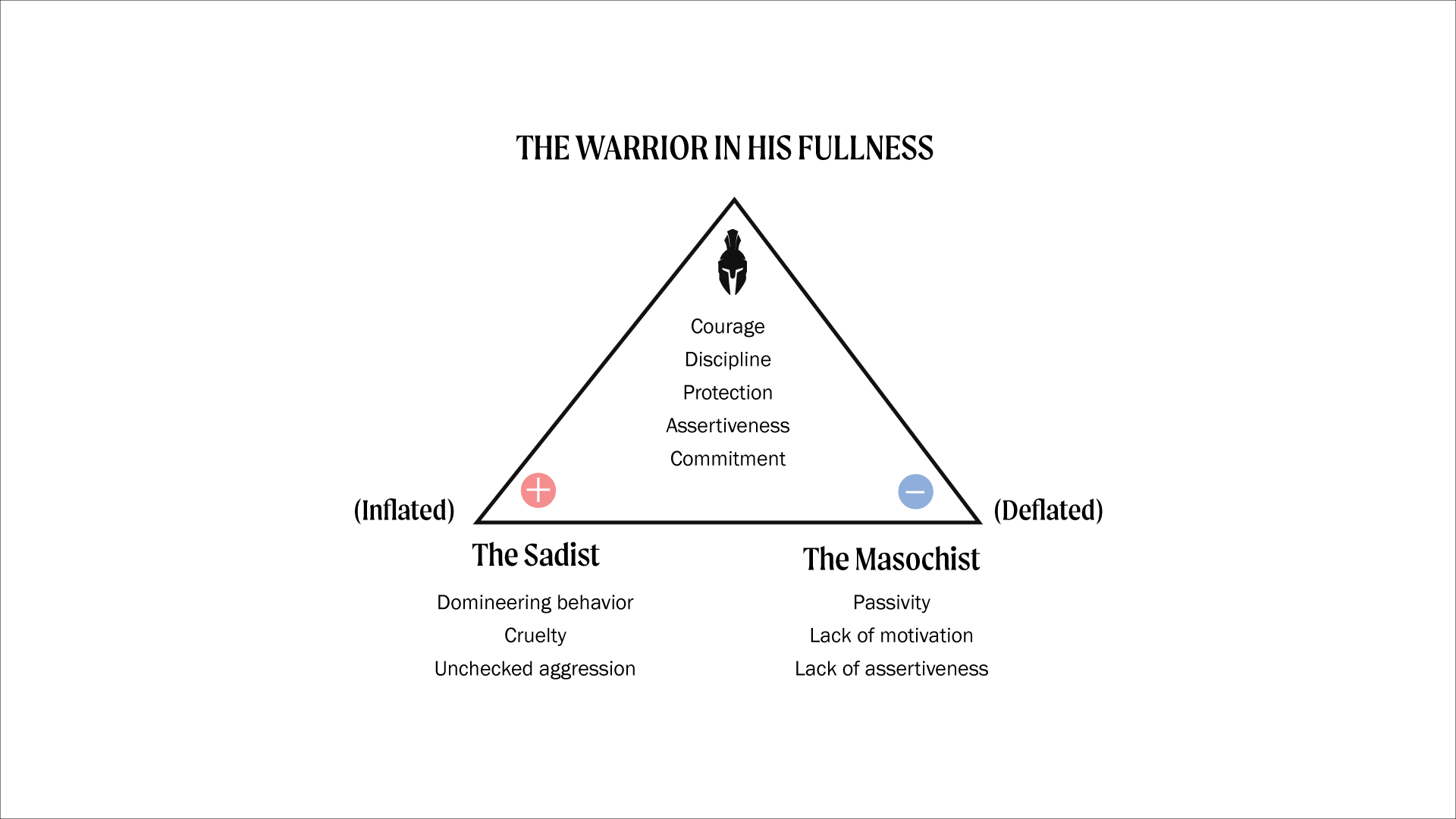
In Robert Moore’s masculine psychology framework, the Shadow Warrior represents the immature expression of warrior energy. This shadow manifests in two forms: the Sadist (excessive aggression) and the Masochist (self-sabotage and avoidance). When warrior energy is repressed or unbalanced, men experience chronic fear of confrontation, discipline collapse, and passive-aggressive behavior.

What is Robert Moore's Warrior Archetype?
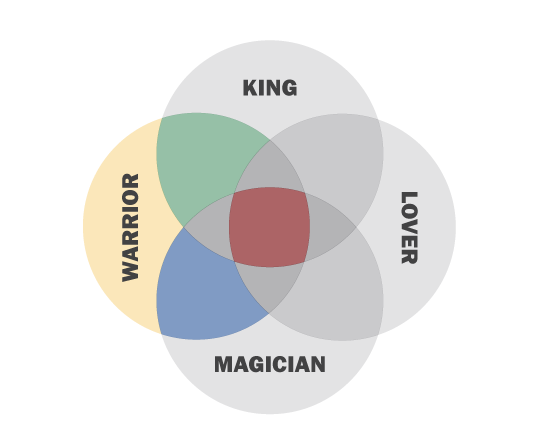
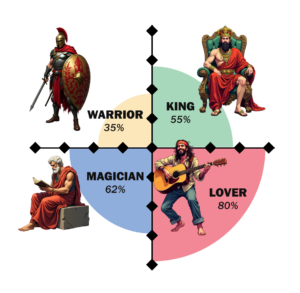
Dr. Robert Moore’s archetypal psychology identifies four primary structures in the masculine psyche: King, Warrior, Magician, and Lover. The King represents order, blessing, and fertility—the organizing principle at the center of your psychological world. The Magician embodies awareness, knowledge, and introspection—your capacity to know, interpret, and develop inner wisdom. The Lover is the archetype of appreciation, delight, and valuing—enabling joy and connection to life’s pleasures.
The Warrior archetype is your source of action, discipline, focus, and commitment to something beyond yourself. It enables decisive action, strategic thinking, boundary-setting, and the capacity to fight for what matters. Its core virtues include loyalty, fidelity, duty, and devotion to transpersonal values—what Moore describes as service to the “right order” or the sacred King. Without connection to the King archetype, you become merely a mercenary or killer rather than a true warrior.
The Warrior archetype is dangerous when unintegrated or possessed. In its shadow forms, it manifests as gratuitous violence, paranoia, sadism, or conversely as passive-aggression and masochistic submission. Moore points to everything from domestic violence to warfare as expressions of Warrior pathology—most violence stems from its distortion in immature “boy psychology.” The challenge isn’t to eliminate this archetype or be possessed by it, but to develop a conscious relationship with it through the ego-Self axis.
The Two Faces of the Shadow Warrior
The Sadist: Aggression Without Purpose
Characteristics: Cruelty, Domination, Violence Without Honor
The sadistic Warrior is possessed by archetypal energy and has become what Moore calls “a killing machine just as deadly as Jaws and no more human than Jaws.” This is the man who justifies all violence as righteous—he’s the “red knight” overwhelmed by rage, convinced his victims “richly deserved it.” Moore describes the active-independent or sociopathic personality whose motto is “any moment of humanity is weakness.” He’s totally cynical, believes “everybody does it,” and uses power against the defenseless without hesitation or remorse.
Real-World Manifestations
Moore points to everything from domestic abusers to torturers to the Stockton schoolyard killer as examples of sadistic Warrior possession. In relationships, this is the man who erupts in “red knight” rage, convinced his partner deserves punishment for displeasing him. At work, it’s the boss who sadistically humiliates employees, the cop who uses excessive force, or the executive who ruthlessly destroys anyone who questions him. Moore emphasizes: “Torturers are not bad folks, see, they’re just punishing these bad folks”—they experience their cruelty as righteous duty.
Why This Happens (Disconnection from King Energy)
The sadistic Warrior emerges when there’s no King to serve—no transpersonal values, no sacred order, no commitment beyond ego. Moore states clearly: “You don’t have a sacred king, you’re not a warrior. You may be a killer.” Without the King providing legitimate authority and purpose, the Warrior becomes a mercenary whose “gun is for hire to the highest bidder.” He also lacks the Magician’s discrimination (can’t tell real enemies from projections) and the Lover’s capacity to value human life, making him capable of atrocities without conscience.
The Masochist: The Warrior in Retreat
Characteristics: Avoidance, Self-Sabotage, Chronic Fear
The masochistic Warrior projects his power onto others and takes the victim role. Moore describes this as the man who says “I can’t”—the motto of someone completely out of touch with Warrior energy. This is chronic passivity, compulsive niceness, and what Moore calls “the dependent personality disorder” that “always takes the role of the fair maiden, not the knight.” He feels powerless, blames others (especially women) for his weakness, and experiences his partner as an all-powerful “commanding whore”—a displeased goddess he’s terrified of.
How This Shows Up in Daily Life
In daily life, the masochistic Warrior manifests as endless procrastination—you know what you should do but never take action. Moore notes: “There are a lot of people that live their lives that way… every day, the day comes and it goes and the day comes and it goes with no warrior, no strategy, no battle plan.” You’re compulsively compliant at work, brown-nosing your boss more than necessary, unconsciously inviting abuse with what Moore calls a “kick me sweatshirt.” You passive-aggressively sabotage through “forgetting,” being late, or subtle undermining—expressing aggression in covert ways while maintaining plausible deniability.
The Cost of Staying in This Shadow
The cost is depression, rage, and failed relationships. Moore states bluntly: “Show me a passive aggressive male, I’ll show you an angry male… Show me a passive aggressive man, I’ll show you a depressed man.” You’re “seething” with unexpressed rage while feeling like a perpetual victim. In relationships, you oscillate between supplicant boy and explosive god—”I’m sorry, it’ll never happen again, I’ll do anything” followed by archetypal rage breaking through. Without access to healthy Warrior energy, you have no capacity for commitment, boundaries, or the stamina to sustain anything meaningful.
Signs You're Living in Shadow Warrior Energy
Raw/Inflated/Sadistic Shadow:
- You justify your rage as “righteous indignation”—convinced your anger is always warranted
- You can’t stand being questioned or criticized—it feels like an attack on your honor
- You see enemies everywhere and scan constantly for threats, even when there aren’t any
- You use force or intimidation on people who are defenseless or weaker than you
- You’re loyal to your own ego and career, not to anything transpersonal or sacred
Repressed/Deflated/Masochistic Shadow:
- You procrastinate endlessly and rarely take decisive action on what you know you should do
- You’re compulsively “nice” and compliant, but seething with resentment underneath
- You feel like a victim in your relationships, especially with women—blaming them for your powerlessness
- You’re chronically depressed and lack energy, passion, or commitment to anything meaningful
- You passive-aggressively undermine others through “forgetting,” being late, or subtle sabotage
Both:
- You swing between explosive rage and complete shutdown—no middle ground
- You have violent, sadistic figures appearing regularly in your dreams
Why the Shadow Warrior Develops
The shadow Warrior develops when a man lacks proper masculine initiation and connection to healthy models. Moore emphasizes that “it’s very interesting that if you don’t have a lot of the qualities of the warrior, it’s going to be hard to form a lasting relationship. But if you don’t have a good bit of the warrior and the qualities of the warrior you won’t be able to keep going.”
Without a father or mentor who actively claims a son and draws him into masculine orbit, the boy remains psychologically fused with the mother archetype—not the actual mother, but the Great Mother of the unconscious. Moore states: “If father is not there, and if father is not very assertive in moving in and claiming a son, then the mother is going to be put in a very bad position because she’s going to be left with this experience. The son will experience her as all this tremendous power, and the son may hate her guts not for any fault of her own, but because the father has not come in and drawn the son into his orbit of emotional functioning.”
This failure of initiation leaves men either inflated with grandiose warrior energy they can’t control, or deflated and passive-aggressive, projecting their power onto others. The result is what Moore calls “boy psychology”—the source of most violence, torture, and gratuitous oppression in the world.

The Cost of Ignoring Your Shadow Warrior
Here’s what ignoring your Warrior energy could cost you over your lifetime:
Fear of Failure Paralyzes You: You’ll continue avoiding challenges that test your strength. Every difficult conversation becomes something you put off. Every hard decision gets delayed. The fear of failing keeps you from even trying, so you stay stuck in patterns that don’t serve you. You’ll watch opportunities pass by while you wait for the “perfect moment” that never comes.
Chronic Avoidance Becomes Your Default: Confrontation feels impossible. Setting boundaries feels dangerous. Standing up for yourself feels too risky. So you say yes when you mean no. You let people walk over you. You swallow your truth to keep the peace. The resentment builds, but you tell yourself it’s easier this way. It’s not—it’s killing you slowly.
Discipline Crumbles: Without your Warrior, you can’t stick to anything. The workout plan lasts three days. The business idea stays in your head. The project you started six months ago sits unfinished. You know what you should do, but you can’t make yourself do it. There’s no follow-through, no commitment, no capacity to endure discomfort for something that matters.
Physical Decline Accelerates: Your body reflects your inner state. You feel yourself getting weaker, softer, less vital. The energy fades. The sharpness dulls. You look in the mirror and don’t recognize the man staring back. Without the Warrior’s discipline, your physical presence diminishes—and with it, your confidence and self-respect.
Passive Aggression Poisons Your Relationships: When the Warrior is repressed, the aggression doesn’t disappear—it goes underground. You become irritable, critical, subtly hostile. You punish people in ways you don’t even recognize. Your partner feels your resentment but can’t name it. Your colleagues sense your frustration but you deny it. The anger leaks out sideways, damaging everything it touches.
You Lose Your Sense of Purpose: The Warrior is what gives you the capacity for commitment to something beyond yourself. Without it, life becomes a series of reactions rather than intentional actions. You drift. You settle. You stop believing anything is worth fighting for. The fire goes out, and what’s left is a man going through the motions with no real conviction.
How to Integrate the Shadow Warrior
Practical, actionable steps:
Dream work – Watch for warrior motifs in your dreams, especially sadistic or violent shadow figures. When you’re the Nazi killer in your dreams, you’re getting better—it means the energy is coming into consciousness.
Active imagination – The most powerful technique. Visualize yourself in a room, invite your inner Warrior in, and dialogue with him. Ask: Who are you? Why are you so violent? How have you been manifesting in my life? Let him confront you—he’ll be more honest than any therapist.
Develop the ego-Self axis – You can’t eliminate the Warrior archetype, and you don’t want to be possessed by it. The goal is conscious relationship—accessing the energy without being overwhelmed by it. This takes time, like building muscle.
Balance with the other archetypes – The Warrior needs the King to serve, the Magician to provide awareness and discrimination, and the Lover to prevent becoming a killing machine. Integration means all four working together.
Ritual containment practices – Create regular practices to monitor your relationship with Warrior energy. Traditional cultures used ritual spaces to connect with archetypal energies safely—you need modern equivalents.
Men’s work and Jungian analysis – Work with guides who understand archetypal psychology. The Warrior can’t be integrated alone—you need containment and support from those further along the path.
Physical discipline – Engage practices that activate Warrior energy consciously: martial arts (especially those with spiritual dimensions like Kendo), endurance training, or structured physical challenges that require commitment beyond ego.
The Integrated Warrior: What Healthy Warrior Energy Looks Like
The integrated Warrior serves something beyond himself. Moore emphasizes that “a true knight” operates “on behalf of the right order” and “does not act out of some personal schema.” This is the man who can take decisive action without being driven by ego or rage—he knows his enemy and can distinguish real threats from projections. Healthy Warrior energy means you act when action is needed: you don’t procrastinate, ruminate, or endlessly study the problem.
The integrated Warrior embodies the knighthood virtues: loyalty, fidelity, commitment to transpersonal values, and faithfulness. Moore states clearly: “Faithfulness is a warrior virtue. You don’t have this thing, you don’t know even the slightest idea about devotion or faithfulness to anybody, to anything.” This is the man who makes commitments and keeps them—in marriage, in work, in service to what matters—with the stamina to persist through difficulty and the discipline to stay the course.
Critically, the mature Warrior knows when not to fight. Moore describes the Kendo master who, when challenged by a young swordsman, simply takes him across the river and leaves him there—refusing to kill unnecessarily. The integrated Warrior has “buttoned up”—he has boundaries and can contain his power without using force against the defenseless. He serves the King, is guided by the Magician’s wisdom, and is tempered by the Lover’s capacity to value human life.

Balance your Warrior within
The Sovereign Man course helps you awaken and integrate your Warrior energy through shadow work exercises, practical rituals, and a brotherhood community where strength is cultivated.
Frequently Asked Questions
The sadistic shadow is when you identify with the Warrior archetype and become possessed by it—you're the inflated, grandiose killer who justifies violence as righteous. The masochistic shadow is when you project the Warrior onto others and submit to it compulsively, becoming what Moore calls passive-aggressive: "Show me a passive aggressive male, I'll show you an angry male." The sadist acts out violence directly; the masochist feels powerless, blames others for his weakness, and acts out rage in covert ways.
Absolutely—Moore states that "usually it's a combination of both." The classic pattern is oscillating between explosive rage and complete shutdown, or being compulsively nice on the surface with a sociopath in the unconscious. You might be passive-dependent until the archetypal energy breaks through your defenses, then you explode in sadistic rage.
This is lifelong work, not a destination. Moore is clear: "You never transform these archetypal patterns out of existence... They're always there." The goal is developing an ongoing conscious relationship through the ego-Self axis—even after years of work, you remain vulnerable to possession.
The shadow Warrior is deeper—it's what Moore calls "boy psychology," immature males either possessed by archetypal energy or completely cut off from it. Moore states: "The biggest problem is not all masculine aggression. The biggest problem is masculine passive aggression." The solution isn't eliminating masculine assertiveness—it's developing mature access to it in service of something beyond ego.
The Warrior must be balanced by and serve the other three archetypes. Moore emphasizes: "To be a warrior in the truest sense, you have to have a king... You don't have a sacred king, you're not a warrior." Without the Magician, the Warrior lacks discrimination; without the Lover, he becomes a killing machine with no capacity to value human life.
You can't fix it alone—Moore is emphatic that "if you're possessed by any archetype, you're not going to get out of it yourself because you are identified." You need outside help: dream work, active imagination, Jungian analysis, or men's work with guides who understand archetypal psychology. The key is creating containment and support while slowly building ego strength to relate to the energy consciously rather than being overwhelmed by it.
Listen to lectures on the Warrior within
Explore the depths of the sacred Warrior archetype and its profound implications for understanding the masculine psyche.
Explore our YouTube channel for videos breaking down the Warrior archetype and lectures from Dr. Robert Moore that illuminate what it means for your daily life.
Are you new here?
Take the free King Warrior Magician Lover test and discover what your archetypal energy is.