

The Shadow Magician: Understanding the Detached and Manipulative Masculine Mind
In Robert Moore’s masculine psychology framework, the Shadow Magician represents what happens when the archetype of awareness, interpretation, and ritual leadership becomes distorted. Unlike the integrated Magician who brings discernment, disenchantment from illusion, and healing wisdom, the Shadow Magician manifests in two primary patterns: the Detached Manipulator (cold, voyeuristic, using knowledge for power without conscience) and the Denying Trickster (compulsive deconstruction that destroys self-esteem and prevents action). When magician energy is repressed or unbalanced, men experience chronic detachment from relationships, inability to act on knowledge, literalism that misses symbolic depth, and what Moore calls “enchantment”—a determined not-knowing that keeps destructive patterns invisible.

What is Robert Moore's Magician Archetype?
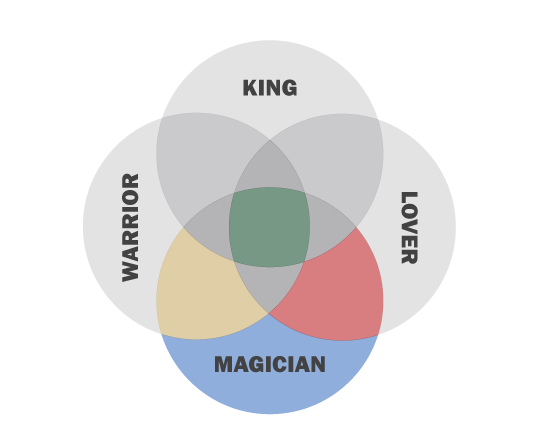
The Magician stands alongside the King, Warrior, and Lover as one of four foundational masculine energies. This is the archetype of awareness and interpretation—your capacity to break through denial, recognize destructive patterns, and understand the deep structures of the psyche. The Magician provides what Moore calls “the keys to the kingdom”—the ability to navigate different spaces within yourself and guide others through transformation.
Moore calls the Magician’s domain “transformative space”—the liminal zone where change occurs. This is the most introverted of the four archetypes, concerned with understanding, ritual leadership, and inner work. Without this energy online, you’re operating in what Moore calls “enchantment”—a determined not-knowing that keeps you trapped in denial.
The reality: most men are either detached from this energy (leading to massive denial and inability to see what is) or inflated by it (leading to paralysis by analysis and grandiose isolation). Integration requires using knowledge in service of life, not as a refuge from it. As Moore warns: “If all you’ve got is magician energy, you’re going to lose—you can study and understand the problems, but without warrior firepower, you’re not going to win over them.”
The Two Faces of the Shadow Magician
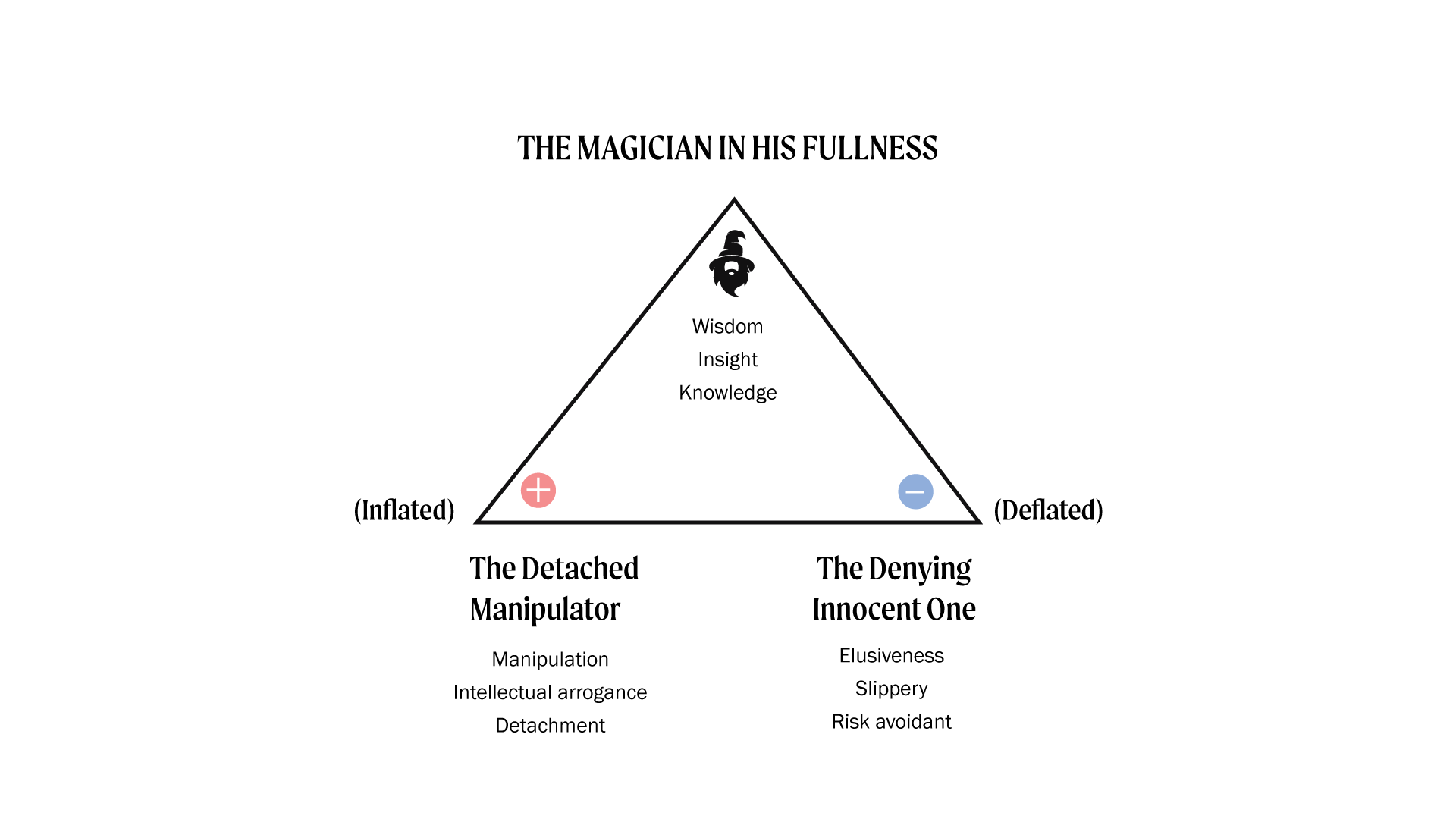
The Detached Manipulator: Knowledge Without Heart
Characteristics:
- Psychosocial detachment and isolation
- Voyeurism—watching life rather than living it
- Using knowledge to manipulate and control others
- “Value-free” theory that serves death rather than life
- Depreciation of action—endless analysis without doing
- Retreat into “grandiose isolation”
Real-world manifestations:
Moore identifies this pattern in academics who never act on their knowledge, therapists who remain coldly detached from clients, scientists who create weapons without moral concern, and intellectuals who deconstruct everything without building anything. The Detached Manipulator has what Moore calls “loads of magician energy” but uses it to avoid intimacy and responsibility.
The “shit happens” mentality: Moore uses the example of the bumper sticker “Shit Happens” as the lowest functioning of the magician—a refusal to understand or interpret what’s occurring. “Just one cut up from that is scapegoat”—finding simple answers to complex problems by blaming others.
Why this happens:
Early relational trauma makes cognitive functions safer than human connection. Moore explains: “When your relationships were so bad in childhood, you cathect your cognitive functions rather than other people.” The person retreats into the mind because the body and emotions feel too dangerous.
The Denying Trickster: The Compulsive Critic
Characteristics:
- Everything reduced to comedy or cynicism
- Compulsive deconstruction of self and others
- Inability to take anything seriously
- Low self-esteem masked as sophistication
- Seeing through authentic authority as well as false
- Nihilism—believing in nothing
How this shows up in daily life:
The person possessed by the Trickster makes everything a joke. Moore notes: “If you’re stupid enough to say anything, they’ll deconstruct you right there.” But the double-edged sword cuts inward: “The trickster deconstructs their self-esteem first. They are unable to take themselves seriously.”
This manifests as:
- The stand-up comic who can’t stop performing
- The cynic who trusts no one
- The man who gives away his power through constant self-deprecation
- The intellectual who criticizes but never creates
- Chronic inability to commit or build anything lasting
The cost of this shadow:
Moore warns: “Show me a cynical, nihilistic man, you got a boy. When you do not have the king, you’re cynical and nihilistic.” The Trickster on automatic pilot prevents maturation because it destroys every foundation before it can be built.
Signs You're Living in Shadow Magician Energy
The Detached Pattern:
- Chronic isolation and preference for solitude over relationship
- Feeling “complete” in your own mental world
- Studying relationships instead of having them
- Voyeuristic relationship to life (watching, not participating)
- Inability to empathize or feel your way into others’ experience
- Endless analysis that never leads to action
- “I don’t need you” attitude masking deep wounding
- When stressed, you buy more books instead of calling friends
The Denying Pattern:
- Massive denial about obvious problems in your life
- Literalism—missing symbolic and metaphorical meaning
- Oversimplification and exaggeration of partial truths
- Scapegoating—blaming simple causes for complex problems
- Fundamentalism of any kind (religious, political, ideological)
- Inability to see evil or destructive patterns until too late
- “Enchantment”—a determined not-knowing
- Depression masking hidden grandiosity
The Trickster Pattern:
- Making everything into a joke, even serious matters
- Chronic self-deprecation and low self-esteem
- Giving away your power through idealizing projections
- Unable to admire without envy
- Deconstructing every authority, including legitimate ones
- Fantasies of being a stand-up comic or critic
- Cynicism about all human endeavors
- Inability to build or commit to anything
Why the Shadow Magician Develops
Relational Trauma and Cognitive Refuge
Moore emphasizes that people retreat into the Magician when early relationships were “more painful than helpful.” The child learns to cathect (invest libido in) cognitive functions instead of people. This creates adults who feel safer with ideas than with intimacy.
Lack of Ritual Containment
Without conscious spiritual practice and ritual leadership, the Magician has no container for its power. Moore stresses: “If you don’t have conscious ritualization in your life, you’re going to find unconscious rituals”—obsessive-compulsive behaviors, addictions to information, or complete detachment.
Inflation Without Integration
When the Magician is not balanced by the other archetypes, it becomes inflated. Moore notes: “When you’re inflated in the magician, you feel complete in that mode. You don’t feel like you’re lacking anything.” This creates the illusion of self-sufficiency that prevents growth.
Cultural Devaluation of Wisdom
Modern culture reduces education to careerism and knowledge to information. Moore observes: “People have got the idea in the United States that the only reason to get an education is to make money.” This wounds the Magician by making wisdom subservient to profit.
The Cost of Ignoring Your Shadow Magician
Over 6-12 Months of Neglect:
Relational breakdown:
- Chronic isolation and inability to form intimate bonds
- Others experience you as cold, detached, unavailable
- Relationships reduced to intellectual exercises
- Voyeuristic patterns—living through others’ experiences
- Partners feel studied rather than loved
Paralysis by analysis:
- Endless understanding without action
- “Genetic reductive interpretations” that explain but don’t heal
- Waiting for the perfect understanding before moving
- Life passing by while you study it
- Depression from disconnection masked as sophistication
Moral blindness:
- Inability to recognize evil until it’s too late
- “Value-free” positions that actually serve destruction
- Complicity through detachment
- Ecological indifference rationalized as objectivity
- Becoming what Moore calls “the scientist without a heart”
Loss of meaning:
- Cynicism and nihilism replacing vision
- Deconstruction without reconstruction
- No story worth living for
- Chronic boredom despite intellectual stimulation
- Existential despair masked as intellectual sophistication
Moore’s stark warning: “If you lose your temper a lot, it’s because you’re afraid. But if you’re depressed a lot, it’s because you’re not seeing. Depression is based on hidden grandiosity—some hidden inflation you cannot see.”
How to Integrate the Shadow Magician
1. Break Through Denial with Disenchantment
Develop your “bullshit indicator” to see through enchantment in yourself and social systems—Moore calls this the very first task of the magician within. Ask yourself: “How sad am I compared to how depressed?” Sadness means you’re seeing reality; depression indicates hidden denial you haven’t yet confronted.
2. Develop Discernment About Evil
Learn to “see the dragon”—recognize malignant destructiveness in yourself first, then in social systems. Study comparative mythology of evil and understand that pathological infantile grandiosity is the root of destructive behavior.
3. Move from Understanding to Action
Channel energy with “the wand”—assume responsibility for empowering the aspects of your psyche that have been left out. Map your four quadrants, work on the opposite of your strength, and always ask: “What is this knowledge for? What does it serve?”
4. Active Imagination with the Inner Magician
Establish regular contact with your inner shaman or wise elder through daily dialogue—this should not be mystified or out of reach. Use Robert Johnson’s Inner Work as a guide, journal regularly with this figure, and keep coming back respectfully until the true healer appears.
5. Immerse in Comparative Mythology
Planetary consciousness requires cross-cultural mythological literacy—Moore calls this “stewarding the human stories.” Start with Joseph Campbell’s complete works, then move to Mircea Eliade, Carl Jung’s Collected Works, Victor Turner on ritual, and Elie Wiesel’s Souls on Fire.
6. Develop Hermeneutic Subtlety
Move beyond literalism by cultivating the capacity for nuanced, symbolic interpretation—without this, you over-concretify and exaggerate everything. Study poetry, learn to distinguish symbol from sign, and read systematic thinkers like Whitehead or Tillich to humble your grandiosity.
7. Establish Ritual Practice
Create conscious containers through daily spiritual practice—without ritual, the Magician operates unconsciously through compulsions. Participate in men’s groups that provide ritual space, study ritual process, and become a ritual elder for others by taking responsibility for initiation.
The Integrated Magician: What Healthy Magician Energy Looks Like
When the Magician is consciously accessed and balanced by the other archetypes, you develop clear seeing without cynicism—the world is seen accurately, including its darkness, but without nihilistic despair. Moore describes this as becoming “a man of sorrows and acquainted with grief”—you’re sad about reality, not depressed by denial. You can recognize evil and destructive patterns while maintaining empathy, and as Moore insists, the integrated Magician “will never leave people in despair and without a vision.”
Your knowledge serves healing and creation, not manipulation or detachment. You gain what Moore calls “the keys to the kingdom”—the ability to recognize different spaces of the psyche, know when you’re in them, and help others access them. Moore emphasizes the shaman as the apex of Magician development—one who “integrates the virtues of all sides of the male psyche.”
You take responsibility for guiding others through initiation and transformation, understanding that every man needs to be a ritual elder. Your understanding leads to appropriate action—you don’t just study problems, you channel energy toward solutions. As Moore envisions: “The fully initiated man has figured out what that warrior energy is for—not to rape and dominate the weak, which most men in history never figured out.”

Balance your Magician within
The Sovereign Man course helps you awaken and integrate your Magician energy through shadow work exercises, practical rituals, and a brotherhood community where strength is cultivated.
Frequently Asked Questions
The Detached Manipulator has excessive Magician energy that isolates him from relationship and action. The Denying Trickster has Magician energy on "automatic pilot"—compulsively deconstructing everything, including his own self-worth. Both lack integration with the other archetypes.
Yes. Moore describes how the Trickster can operate compulsively while the person also retreats into detached isolation. The common thread is that the Magician is not serving the whole personality—it's either overwhelming or undermining the human self.
Moore emphasizes this is lifelong work. However, he notes: "I have never seen men or women who could not get a hold of this fairly quickly when they just have it laid out." The key is consistent practice—daily active imagination, ongoing study, and regular ritual participation.
Not exactly. Being intellectual is fine if balanced. The shadow appears when knowledge serves detachment rather than connection, when understanding replaces action, or when analysis becomes a defense against feeling. Moore: "Just because you are getting insights into some important scientific theory does not mean you are an initiated male personality." /p>
The Magician is in dialectical opposition to the King. Moore explains: "The magician has to stop being a deconstructionist and start using his knowledge and power to serve the creation of a just order." The Magician also needs the Warrior for action and the Lover for embodied connection.
Because the Magician's primary task is disenchantment—seeing through illusion to reality. When the Magician malfunctions, massive denial results. Moore: "Anytime you get this massive denial, the magician is not functioning properly."
Listen to lectures on the Magician within
Explore the depths of the sacred Magician archetype and its profound implications for understanding the masculine psyche.
Explore our YouTube channel for videos breaking down the Magician archetype and lectures from Dr. Robert Moore that illuminate what it means for your daily life.
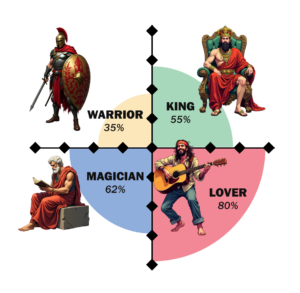
Are you new here?
Take the free King Warrior Magician Lover test and discover what your archetypal energy is.