
The Shadow Warrior: Understanding the Dark Side of Masculine Strength
In Robert Moore’s masculine psychology framework, the Shadow King represents the immature or pathological expression of king energy. This shadow manifests in two primary forms: usurpation (identifying with the archetype and becoming tyrannical) and abdication (projecting the archetype onto others and becoming powerless). When king energy is repressed or inflated, men experience chronic depression, lack of purpose, inability to create order, and either dominating or dependent relationships.

What is Robert Moore's King Archetype?
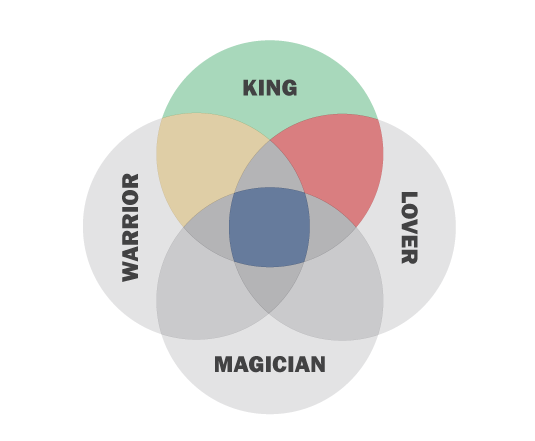
Dr. Robert Moore’s archetypal psychology identifies four primary structures in the mature masculine psyche: King, Warrior, Magician, and Lover. The King represents order, blessing, fertility, and the organizing principle at the center of your psychological world. It’s your capacity to create cosmos from chaos, to bless and empower others, to take responsibility for something beyond yourself, and to provide the center that holds everything together.
The King archetype is the source of meaning, purpose, vocation, and transpersonal values in a man’s life. It enables the capacity for stewardship—caring for the world and others without possessing or dominating them. Its core functions include creating order (cosmos vs. chaos), sacrifice (doing what is necessary for the realm to flourish), stewardship (responsible care without ownership), and blessing (empowering others through recognition and validation).
The King archetype is dangerous when unintegrated or possessed. In its shadow forms, it manifests as tyranny, narcissism, paranoia, or conversely as chronic depression, abdication of responsibility, and dependency. Moore points to everything from domestic tyranny to political totalitarianism as expressions of King pathology—most evil stems from its distortion in immature “boy psychology.” The challenge isn’t to eliminate this archetype, but to develop a conscious relationship with it through the ego-Self axis.
The Two Faces of the Shadow King
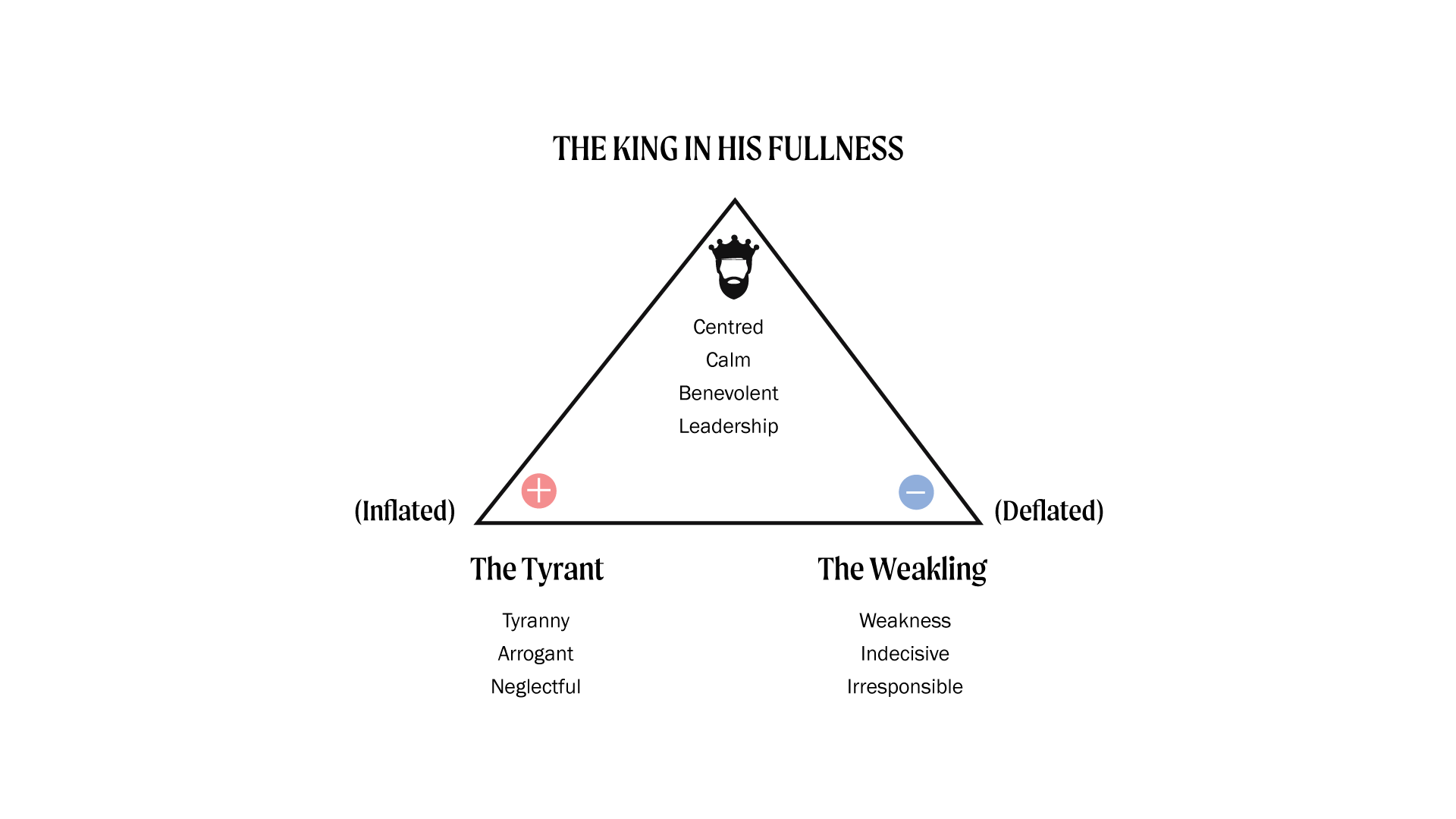
The Tyrant: Usurpation and Domination
Characteristics: Paranoia, Cruelty, Destruction of Order
The tyrannical King emerges when a man identifies with the King archetype rather than relating to it consciously. Moore describes two forms of this usurpation: the active-independent (sociopathic/antisocial personality) and the passive-independent (narcissistic personality disorder). Both create chaos rather than cosmos, curse rather than bless, and cannot empower others.
The Active-Independent Tyrant (Sociopathic King)
This is the man possessed by King energy in its most paranoid, violent form. Moore describes him as “constantly scanning” for threats, believing “if I’m not standing on your neck, you’re standing on mine.” His worldview is totally vertical—pure domination. He’s the Stalinist leader who cannot tolerate any independent organization because it threatens his hegemony.
Key characteristics:
- Paranoid to the core—always looking for palace coups, even inventing them
- Preemptive strike mentality—destroys any emerging order he doesn’t control
- Creates chaos rather than cosmos—”anytime cosmos organizes, he tries to destroy it”
- No moral limits—totally cynical, uses power without hesitation
- Sacrifices others—”I will sacrifice you when I need you”
Moore points to Stalin, Caligula, and King Saul as examples. This is the father who “calls in an airstrike anytime the son even looks like he has any self-esteem.” It’s the boss who cannot stand anybody having initiative. The leader who sends in tanks when students talk about democracy because he sees it as anarchy.
The Passive-Independent Tyrant (Narcissistic King)
This is the more benign but still pathological form—the classic narcissistic personality disorder. Moore notes: “If you just adore them and admire them and mirror them, they calm down.” This is the man who needs constant validation, whose motto is essentially “tell me how wonderful I am.” Unlike the active-independent, he can be temporarily satisfied by flattery—but it ages quickly.
Key characteristics:
- Needs constant mirroring—requires endless admiration to feel secure
- Entitled to everything—feels exempt from expectations made of others
- Cannot stand autonomy in others—needs people dependent on him
- Flies into rage when not adored—irritability signals rising anxiety
- Exploits without conscience—only knows “throw away people”
This is the “shiny Puer,” the golden boy made into a god by his mother. He’s the professor who needs students to think he’s brilliant, the executive who needs constant validation. He’s less violent than the active-independent but equally unable to empower others.
Real-World Manifestations
In Relationships: The tyrannical King creates sadomasochistic dynamics. Moore emphasises: “Anytime you’re on this side of the shadow king, you do not want a queen in your life. You want a lot of consorts.” He cannot empower a partner—only control or consume them.
At Work: The shadow King boss cannot delegate or tolerate competence in others. Moore notes the paradox: “If I create the army I need to maintain my hegemony, I have got to create some powerful generals… The minute I do that, I’m at risk.” So he keeps everyone weak and dependent.
In Parenting: The tyrannical father “attacks any glimmer of masculine power in the son.” Moore describes fathers who are “really nice sometimes, but when he gets to drinking, this killer king comes out and starts blasting the son.” The result is sons who either become tyrants themselves or completely abdicate their power.
Why This Happens (Identification with the Archetype)
The tyrant emerges through identification with the King archetype rather than relationship to it. Moore is emphatic: “You don’t want to identify with it because if you identify with it, the 220,000 volts fries you out, gets you killed.” When the ego identifies with archetypal King energy, the man believes he IS the king rather than serving the king within.
The consequences of identification:
- Loses capacity for stewardship—everything becomes possession rather than care
- Cannot bless others because their growth threatens his inflation
- Creates chaos rather than cosmos because others’ order threatens his control
- Lives in constant anxiety because he knows he’s a fraud
Moore explains: “By definition, from a Jungian point of view, if your ego is identifying with an aspect of the archetypal self, you will be carrying massive anxiety.”
The Weakling: Abdication and Dependency
Characteristics: Powerlessness, Depression, Chronic Passivity
The abdicating King emerges when a man projects the King archetype onto others rather than relating to it within himself. Moore describes two forms: the passive-dependent (dependent personality disorder) and the active-dependent (histrionic personality). Both refuse responsibility, create chaos through passivity, and cannot empower themselves or others.
The Passive-Dependent Abdicator
This is the man who says “I can’t” and means it. Moore describes him as “completely out of touch with Warrior energy,” someone who “does not want any of this king stuff.” He projects power onto others—especially women—experiencing his partner as a “commanding whore,” a displeased goddess he’s terrified of.
Key characteristics:
- Chronic passivity—”Every day comes and goes with no warrior, no strategy, no battle plan”
- Compulsive compliance—brown-nosing the boss, unconsciously inviting abuse
- Victim mentality—blames others (especially women) for his weakness
- Hidden grandiosity—”I would be a king, but there’s too much sacrifice”
Moore emphasizes the hidden inflation: “The dependent is really grandiose because, well, I would be a king, but there’s too much sacrifice.” This man hasn’t lost his King—he’s keeping it unconscious while expecting someone else to carry it for him.
The Active-Dependent Abdicator (Histrionic)
This is the man “always looking for the king.” Moore describes him as perpetually searching: “Gee, I think it may be you. I’m going to see if I can charm you and get you to choose me.” As soon as he’s chosen, he discovers it’s not the right king after all.
Key characteristics:
- Compulsively promiscuous allegiances—flips from king to king, guru to guru
- Enthusiastic but unstable—makes commitments intensely but they “age quickly”
- Perpetual disappointment—always discovering the “clay feet” of those he idealizes
- Quick death of meaning—”sedimentation” of any insight or commitment
- Trust repeatedly broken—”I will serve you faithfully, I think”
This is the man who’s been in 14 different cults, always looking for the true king. He kneels at your knee saying “Yes, I will serve you faithfully”—until he doesn’t feel like it anymore.
How This Shows Up in Daily Life
Chronic Depression and Meaninglessness: Moore states bluntly: “If you feel worthless as a man, this archetypal reality has not enabled you to constellate that sense of value.” Without King energy, there’s no sense of vocation, purpose, or transpersonal values. “I’m a successful lawyer. But I’m depressed all the time.”
Codependent Relationships: The dependent man creates “bogus centers” in relationships. Moore explains: “Codependency is an agreement that you make with somebody else that neither one of you will grow up.” The dependent man typically marries a narcissistic partner, creating a sadomasochistic dynamic where neither empowers the other.
Inability to Create Order: The abdicating man cannot create cosmos in his life—his home, his work, his relationships remain chaotic because he has no organizing center. “If your connection with the king is not good, what it does to your capacity to mirror others” is devastating.
Passive-Aggressive Behavior: Though he appears powerless, the dependent man is “seething” with unexpressed rage. He undermines through “forgetting,” being late, subtle sabotage—all while maintaining plausible deniability.
The Cost of Abdication
Moore emphasizes the hidden inflation in abdication: “The dependent personality wants to find somebody that they can latch on to, that will provide order for their existence without them having to make any sacrifice.” The costs include disempowerment in the presence of authority, inability to take responsibility, exploitation by others, no transpersonal values, and failed relationships.
Specific costs:
- “When you go in to talk to your boss… you feel your power disappearing”
- Life is “just too hard”—constant excuse-making
- Advertising and manipulative people exploit the void at his center
- “You don’t care about the rainforest. It doesn’t affect me”
- Cannot empower a partner, only depend on or resent them
Signs You're Living in Shadow King Energy
Raw/Inflated/Tyrannical:
- You cannot tolerate anyone having autonomy or independent ideas around you
- You see threats everywhere and preemptively attack before others can organize
- You create chaos whenever order emerges that you don’t control
- You feel entitled to everything and exempt from rules that apply to others
- You need constant admiration and mirroring to feel secure
- You fly into rage when not adored or questioned
- You exploit others without conscience—”throw away people”
- You cannot empower others because their growth threatens you
Repressed/Deflated/Weakling:
- You feel chronically powerless and blame others for your weakness
- You cannot make decisions or take action without someone else’s approval
- You experience authority figures as all-powerful and yourself as helpless
- You’re compulsively compliant and “nice” but seething with resentment
- You’re always looking for the “true king” to follow—guru, mentor, leader
- You idealize people intensely then discover their “clay feet”
- You make enthusiastic commitments that quickly lose meaning
- You’re chronically depressed with no sense of purpose or meaning
Both Forms:
- You swing between inflation (I’m special/powerful) and deflation (I’m worthless/powerless)
- You have no sense of stewardship—only possession or abdication
- You cannot bless others or feel genuinely blessed yourself
- Your relationships are sadomasochistic—domination or submission, no mutuality
- You have violent, tyrannical, or impotent king figures in your dreams
Why the Shadow King Develops
The shadow King develops when a man lacks proper masculine initiation and fails to form a conscious relationship with the King archetype within. Moore emphasizes that the King archetype itself is not pathological—it’s a biological given, a deep structure in the psyche. The pathology comes from either identifying with it (usurpation) or projecting it onto others (abdication). The critical issue is the failure of blessing—when fathers cannot mediate King energy to their children.
Moore states clearly: “If you didn’t get a blessing mediated, you got what is always there when the blessing isn’t, and that is the curse.” The natural priesthood of the father is to mediate King energy through his gaze, his recognition, his empowerment. When this fails—through absence, abuse, or the father’s own disconnection from King energy—the child receives a curse instead: shame instead of validation, chaos instead of cosmos, withering instead of empowerment. Moore explains: “If this being recognizes you, you were created… The power of creating by the view, by the vision.” Without that constitutive gaze, a man feels he doesn’t fully exist.
The critical distinction is between identifying with the archetype and relating to it. Moore is emphatic: “You don’t want to identify with it because if you identify with it, the 220,000 volts fries you out, gets you killed.” Identification leads to tyranny, paranoia, and eventual destruction; projection leads to dependency, depression, and perpetual victimhood. Moore explains: “Either you have formed up a relationship with these realities so that you’re clear you’re not it, but you’re trying to get an optimum distance with it, or it’s acting out in some way.” In modernity, we’ve lost the “sacred canopy”—the mythic space where King projections could be safely lodged—causing this energy to collapse back into the human realm where it makes us crazy.

The Cost of Ignoring Your Shadow King
Here’s what ignoring your Warrior energy could cost you over your lifetime:
Chronic Anxiety About Your Direction: Without your King, you’ll feel increasingly lost and overwhelmed. You wake up not knowing what you’re building toward. Every decision feels paralyzing because there’s no center, no sense of order in your life. The anxiety gnaws at you constantly—Am I doing enough? Am I going the right way? What’s the point of any of this? You’re adrift with no compass, no kingdom to steward.
Crippling Self-Doubt and Imposter Syndrome: You’ll continue feeling like a fraud in your own life. Even when you achieve something, you can’t own it. You feel unqualified, inadequate, like you’re waiting for someone to expose you. Without the King’s authority within you, you can’t claim your rightful place. You apologize for taking up space. You defer to everyone else. You live like a guest in your own existence.
Inability to Create Order and Structure: Your life becomes chaos. Projects start but never finish. Plans collapse. Your finances are a mess. Your workspace is cluttered. Your schedule is reactive, not intentional. Without the King, there’s no organizing principle, no center that holds everything together. You’re constantly putting out fires instead of building something that lasts.
Failure to Lead or Take Responsibility: You avoid leadership roles even when you’re capable. You don’t want the responsibility because it feels too heavy. So you stay small, stay safe, stay stuck. Your family needs you to step up—you don’t. Your team needs direction—you defer. Your community needs someone to take a stand—you stay silent. The cost of this abdication is that others suffer from your absence, and you know it.
No Sense of Purpose or Meaning: Without the King, life feels empty. You go through the motions but nothing feels significant. You’re successful on paper but depressed in reality. There’s no why behind what you do. No vision. No legacy. No sense that your life matters beyond paying bills and passing time. The void at your center grows, and you try to fill it with distractions that never satisfy.
Inability to Bless or Empower Others: You can’t give what you don’t have. Without your King energy, you can’t mentor, can’t encourage, can’t look someone in the eye and make them feel seen and valued. Your children need your blessing—you can’t give it. Your partner needs you to be a source of strength and stability—you’re not. You become a black hole instead of a source of light, draining energy rather than generating it.
The longer you wait, the harder it becomes to break free from these patterns.
Six months ago, I met a man who scored exactly like you. He said he’d “figure it out eventually.” His business stalled because he couldn’t make decisive moves. His marriage suffered because he couldn’t provide emotional leadership. His kids felt his absence even when he was in the room. He was there, but he wasn’t present.
How to Integrate the Shadow Warrior
Practical, actionable steps:
1. Dream Work and Active Imagination
“Watch for warrior motifs in your dreams, especially sadistic or violent shadow figures”—tyrannical kings, absent authority, yourself acting powerlessly or dominating. Moore’s most powerful technique is active imagination: visualize a room, invite your inner King, and dialog with him directly. “You can work on this yourself, and you can see whether or not you can find such a being in your psyche.”
2. Develop the Ego-Self Axis
“You can’t eliminate the King archetype, and you don’t want to be possessed by it. The goal is conscious relationship—accessing the energy without being overwhelmed by it.” This requires understanding you are NOT the archetype, maintaining “optimum distance,” and ongoing vigilance with firm boundaries against unconscious possession.
3. Study Kingship and Biography
“You want to understand about the king? You’ve got to study the king.” Read Fraser’s Golden Bough, Frankfort’s Kingship and the Gods, and Perry’s Lord of the Four Quarters. Study biographies of men who embodied King energy (Churchill, Lincoln, Gandhi) and shadow Kings (Hitler, Stalin, Caligula), and watch films about kingship.
4. Prayer and Spiritual Practice
“If you can pray as a way to build this ego self-axis, pray. It’s worked for millennia, for most of the human beings in history.” Prayer is “a very quick way to disidentify with God—it’s hard to think you’re God if you’re talking to it.” Use traditional prayers from any authentic tradition to create relationship with the King archetype without inflation.
5. Men’s Work and Jungian Analysis
“If you’re possessed by any archetype, you’re not going to get out of it yourself because you are identified.” You need therapists who understand archetypes, men’s groups that can hold and challenge you, and mentors who can recognize possession. “The key is creating containment and support while slowly building ego strength.”
6. Balance with Other Archetypes
“The King needs the Warrior to serve, the Magician to provide awareness and discrimination, and the Lover to prevent becoming a killing machine.” Without Warrior, you can’t defend the realm; without Magician, you can’t recognize inflation; without Lover, you become cold and unfeeling. Integration means all four working together in dynamic balance.
7. Recognize Transference and Practice Stewardship
Learn to recognize when you’re projecting King onto others (bosses, gurus, fathers) or receiving King projections from others. “Anytime you’re over-idealizing someone… you have enormous murderous ambivalence to it.” Move from possession or abdication to genuine stewardship: take responsibility without ownership, practice blessing others, create cosmos in small ways, and “do what is necessary” for the realm to flourish.
The Integrated King: What Healthy King Energy Looks Like
The integrated King has formed a conscious relationship with King energy without identifying with it. Moore describes this as the postmodern challenge: accessing archetypal power without inflation or projection. “The true king dances cosmos into existence”—he brings order that empowers rather than controls, blesses rather than curses, and practices stewardship without possession or domination.
The healthy King “does what is necessary” for the realm to flourish—willing to sacrifice appropriately but not masochistically. He empowers others to grow up and claim their own power rather than doing everything for them or keeping them dependent. He serves transpersonal values beyond ego—justice, truth, beauty, the sacred—with the understanding that “a true warrior is always committed to the best in civilization as he knows it.” He balances all four archetypes (King, Warrior, Magician, Lover) in dynamic harmony.
The integrated King knows his limitations—true humility means “knowing your limitations so that once you get to know your limitations, then you’ll get the help that you need.” His gaze empowers and constitutes others, making them feel more real and alive rather than withering them with shame or curse. He creates cosmos rather than chaos, enables spontaneous creativity within containers, and cares for the world without possessing or dominating it. Moore emphasizes: “In a mature man, the center isn’t out there. The center is in here, and it is not me.”
Balance your King within
The Sovereign Man course helps you awaken and integrate your King energy through shadow work exercises, practical rituals, and a brotherhood community where strength is cultivated.
Frequently Asked Questions
The tyrannical shadow (usurpation) is when you identify with the King archetype—you think you ARE the king, creating either the paranoid, violent sociopath or the narcissistic personality who needs constant adoration. The dependent shadow (abdication) is when you project the King onto others—you give your power away, creating either the passive-dependent (always powerless, always a victim) or the active-dependent (histrionic, always searching for the true king to follow). Moore states: "Usually it's a combination of both"—you oscillate between inflation and deflation.
Absolutely—Moore emphasizes: "Usually it's a combination of both." The classic pattern is oscillating between tyranny and collapse, inflation and deflation: you might be "passive-dependent until the archetypal energy breaks through your defenses, then you explode in sadistic rage." Both forms share the same root of pathological grandiosity—the tyrant is obviously grandiose, while the dependent has hidden grandiosity, refusing responsibility because unconsciously he believes he should be exempt from ordinary human limitations.
The shadow King creates problems with order, meaning, purpose, and empowerment—without King connection, you have no sense of vocation, no transpersonal values, chronic depression, and inability to create cosmos. The shadow Warrior creates problems with action, discipline, boundaries, and aggression, manifesting as either uncontrolled rage and violence (active) or passive-aggression and inability to fight for anything (passive). Moore emphasizes: "There is no warrior without the king. There are mercenaries without the king, but there are no warriors"—the Warrior needs the King to provide purpose and direction.
Both stem from the same problem: failure to form a conscious relationship with the King archetype. When you can't relate to it consciously, you either identify with it (inflation)—think you ARE the king and become tyrannical—or project it onto others (deflation)—give your power away and become dependent. Moore explains: "Either you have formed up a relationship with these realities so that you're clear you're not it, but you're trying to get an optimum distance with it, or it's acting out in some way"—both are forms of pathological grandiosity, just expressed differently. /p>
Moore notes this creates particular challenges: without a father to mediate King energy, the mother may assign her son the King role (creating narcissistic personality disorder—"my Adonis, my champion"), or the lack of masculine validation creates dependent patterns where you search endlessly for kings to follow. However, Moore emphasizes: "The King archetype is in there. It's not some fantasy"—you can access it through active imagination and dream work, men's groups and mentors, study of kingship and biography, prayer and spiritual practice, and Jungian analysis.
No—Moore is emphatic: "If you're possessed by any archetype, you're not going to get out of it yourself because you are identified." You need outside perspective to see your blind spots, containment when archetypal energy is overwhelming, support from those further along the path, and community to hold you accountable. However, you CAN work with active imagination, dream work, and study on your own as part of the larger process.
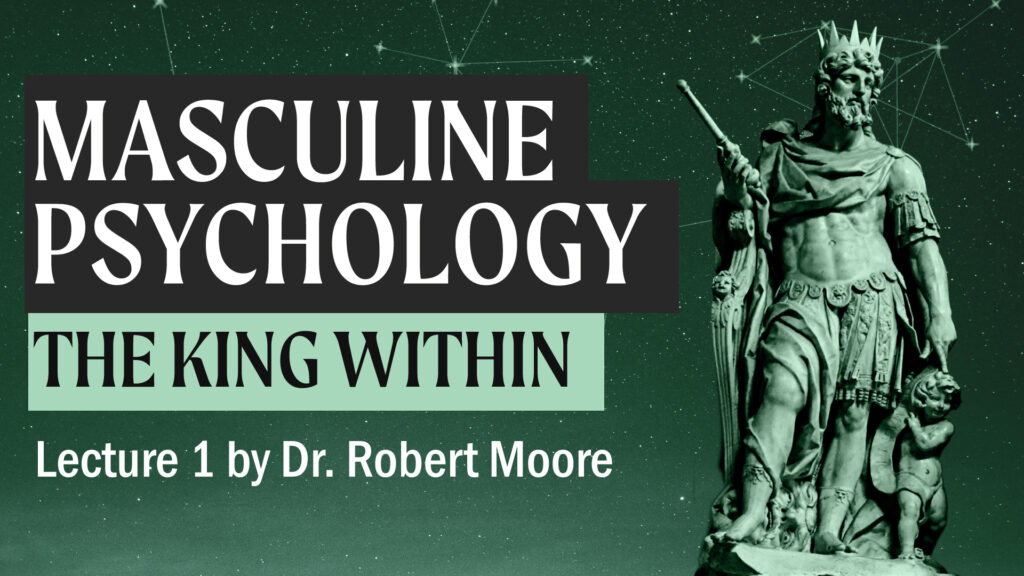
Listen to lectures on the King within
Explore the depths of the sacred King archetype and its profound implications for understanding the masculine psyche.
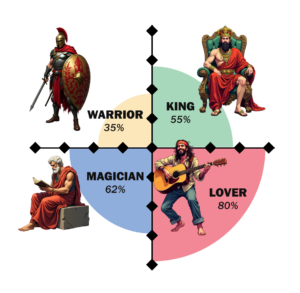
Are you new here?
Take the free King Warrior Magician Lover test and discover what your archetypal energy is.